World Enters “Era of Global Water Bankruptcy”;UN Scientists Formally Define NewPost-Crisis Reality for BillionsA UN report calls for fundamental reset of global water agendaas irreversible damage pushes many basins beyond recovery |
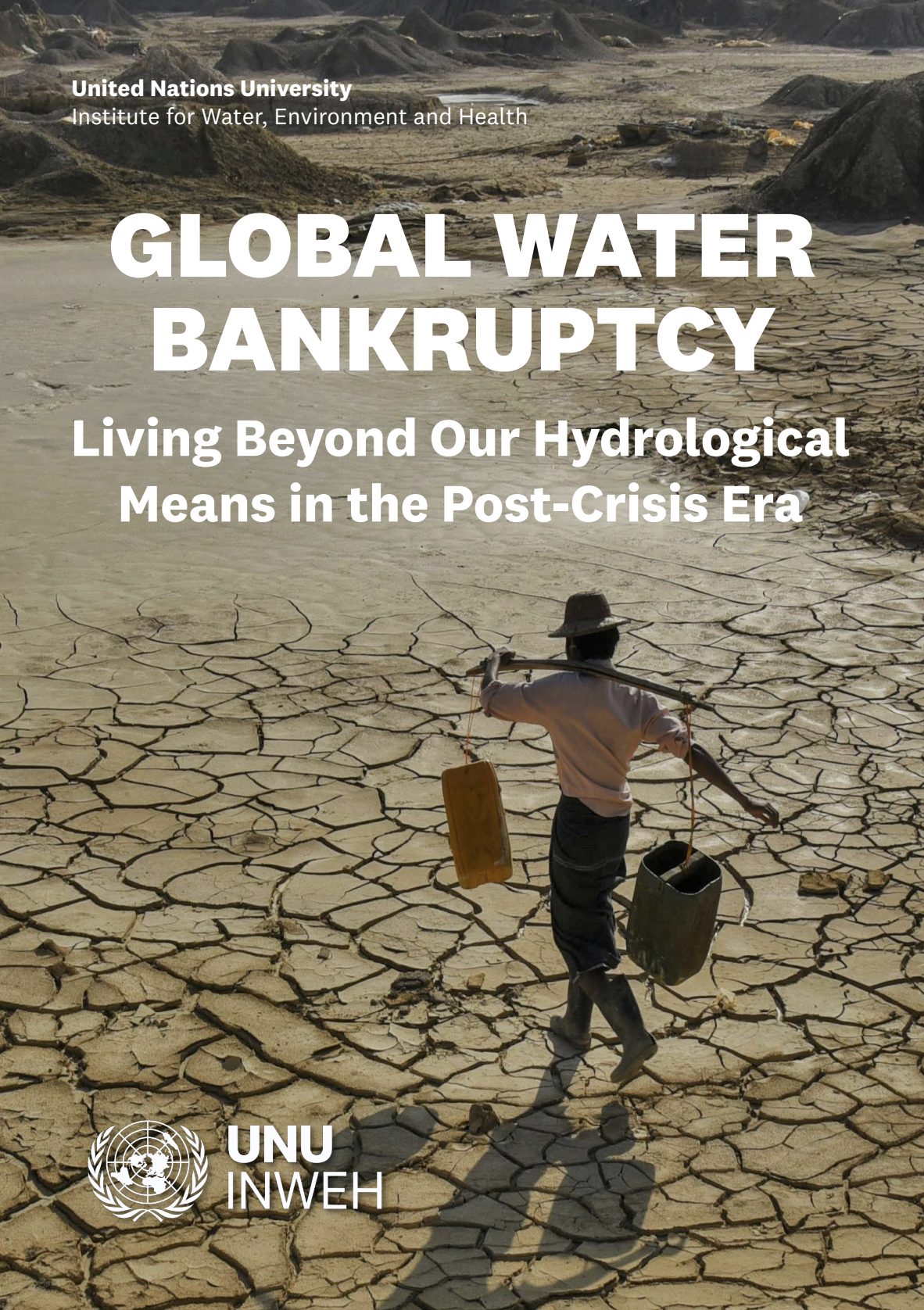
UN Headquarters, New York – Amid chronic groundwater depletion, water overallocation, land and soil degradation, deforestation, and pollution, all compounded by global heating, a UN report today declared the dawn of an era of global water bankruptcy, inviting world leaders to facilitate “honest, science-based adaptation to a new reality.” “Global Water Bankruptcy: Living Beyond Our Hydrological Means in the Post-Crisis Era,” argues that the familiar terms “water stressed” and “water crisis” fail to reflect today’s reality in many places: a post-crisis condition marked by irreversible losses of natural water capital and an inability to bounce back to historic baselines. “This report tells an uncomfortable truth: many regions are living beyond their hydrological means, and many critical water systems are already bankrupt,” says lead author Kaveh Madani, Director of the UN University’s Institute for Water, Environment and Health (UNU-INWEH), known as ‘The UN’s Think Tank on Water.’ Expressed in financial terms, the report says many societies have not only overspent their annual renewable water “income” from rivers, soils, and snowpack, they have depleted long-term “savings” in aquifers, glaciers, wetlands, and other natural reservoirs. This has resulted in a growing list of compacted aquifers, subsided land in deltas and coastal cities, vanished lakes and wetlands, and irreversibly lost biodiversity. The UNU report is based on a peer-reviewed paper to be published in the journal of Water Resources Management that formally defines water bankruptcy as 1) persistent over-withdrawal from surface and groundwater relative to renewable inflows and safe levels of depletion; and 2) the resulting irreversible or prohibitively costly loss of water-related natural capital. By contrast:
The report is issued prior to a high-level meeting in Dakar, Senegal (26–27 Jan.) to prepare the 2026 UN Water Conference, to be co-hosted by the United Arab Emirates and Senegal 2-4 Dec. in the UAE. While not every basin and country is water-bankrupt, Madani says, “enough critical systems around the world have crossed these thresholds. These systems are interconnected through trade, migration, climate feedbacks, and geopolitical dependencies, so the global risk landscape is now fundamentally altered.” Madani underlines the following four essential points:
Hotspots |


In the Middle East and North Africa region, high water stress, climate vulnerability, low agricultural productivity, energy-intensive desalination, and sand and dust storms intersect with complex political economies; In parts of South Asia, groundwater-dependent agriculture and urbanization have produced chronic declines in water tables and local subsidence; and In the American Southwest, the Colorado River and its reservoirs have become symbols of over-promised water. A world in the redDrawing on global datasets and recent scientific evidence, the report presents a stark statistical overview of trends, the overwhelming majority caused by humans:
And the human consequences:
Says Madani: “Millions of farmers are trying to grow more food from shrinking, polluted, or disappearing water sources. Without rapid transitions toward water-smart agriculture, water bankruptcy will spread rapidly.” A new diagnosis for a new eraA region can be flooded one year and still be water bankrupt, he adds, if long-term withdrawals exceed replenishment. In that sense, water bankruptcy is not about how wet or dry a place looks, but about balance, accounting, and sustainability. Says Madani: As with global climate change or pandemics, a declaration of global water bankruptcy does not imply uniform impact everywhere, but that enough systems across regions and income levels have become insolvent and crossed irreversible thresholds to constitute a planetary-scale condition. “Water bankruptcy is also global because its consequences travel,” Madani explains. “Agriculture accounts for the vast majority of freshwater use, and food systems are tightly interconnected through trade and prices. When water scarcity undermines farming in one region, the effects ripple through global markets, political stability, and food security elsewhere. This makes water bankruptcy not a series of isolated local crises, but a shared global risk that demands a new type of response: Bankruptcy management, not crisis management.” A call to reset the global water agendaThe report warns that the current global water agenda – largely focused on drinking water, sanitation, and incremental efficiency improvements – is no longer fit for purpose in many places and calls for a new global water agenda that:
In practical terms, managing water bankruptcy requires governments to focus on the following priorities:
The report underlines that water bankruptcy is not merely a hydrological problem, but a justice issue with deep social and political implications requiring attention at the highest levels of government and multilateral cooperation. The burdens fall disproportionately on smallholder farmers, Indigenous Peoples, low-income urban residents, women and youth while the benefits of overuse often accrued to more powerful actors. “Water bankruptcy is becoming a driver of fragility, displacement, and conflict,” says UN Under-Secretary-General Tshilidzi Marwala, Rector of UNU. “Managing it fairly – ensuring that vulnerable communities are protected and that unavoidable losses are shared equitably – is now central to maintaining peace, stability, and social cohesion.” “Bankruptcy management requires honesty, courage, and political will,” Madani adds. “We cannot rebuild vanished glaciers or reinflate acutely compacted aquifers. But we can prevent further loss of our remaining natural capital, and redesign institutions to live within new hydrological limits.” Upcoming milestones — the 2026 and 2028 UN Water Conferences, the end of the Water Action Decade in 2028, and the 2030 SDG deadline, for example — provide critical opportunities to implement this shift, he says. “Despite its warnings, the report is not a statement of hopelessness,” adds Madani. “It is a call for honesty, realism, and transformation. Declaring bankruptcy is not about giving up, it is about starting fresh. By acknowledging the reality of water bankruptcy, we can finally make the hard choices that will protect people, economies, and ecosystems. The longer we delay, the deeper the deficit grows.” |